
Optima Owner Dependency Audit | Stop Doing Everything, Build a Business That Runs Without You
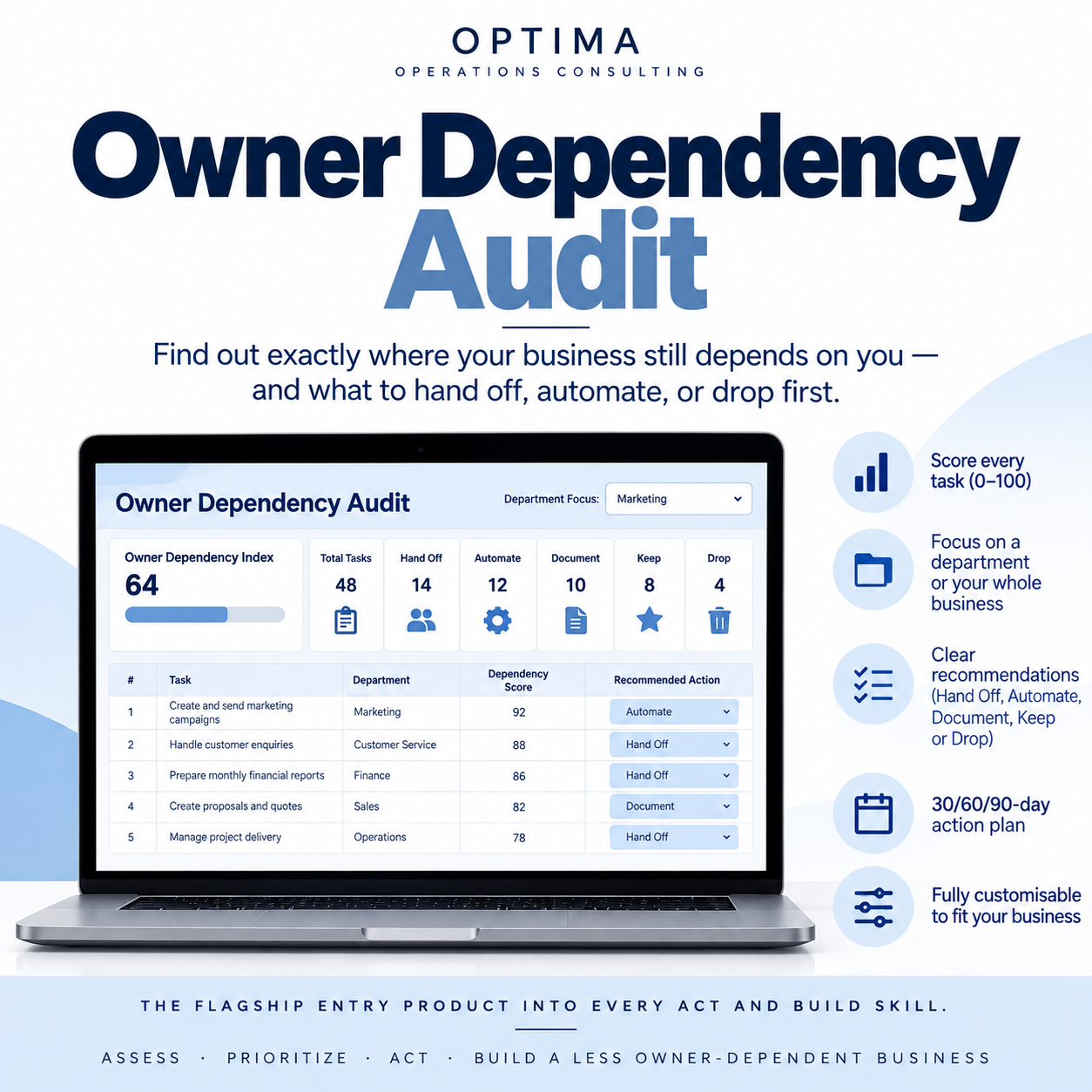
Find out exactly where your business still depends on you — and what to hand off, automate, or eliminate first.
If you stepped away from your business for a week, what would stop?
The Owner Dependency Audit helps you answer that question with data instead of guesswork.
Designed for small business owners who feel like too much still depends on them, this guided AI Skill walks you through your recurring work, scores each task based on its level of owner dependency, and creates a prioritized roadmap for reducing that dependency.
Instead of trying to delegate or automate everything at once, you'll know what to address first, why it matters, and what action to take next.
What the Owner Dependency Audit Does
The Skill evaluates the recurring work happening across your business, or within one specific department, and identifies where your time, knowledge, decisions, and involvement have become operational bottlenecks.
Every task receives an Owner Dependency Score from 0–100 and a recommended next action so you can quickly identify what should be:
HAND OFF: Move the task to another person or role.
AUTOMATE: Use systems, workflows, or AI to reduce manual work.
DOCUMENT: Capture the process before transferring or automating it.
KEEP: Retain owner involvement where your judgment or expertise genuinely adds value.
DROP: Eliminate work that no longer creates enough business value.
The goal isn't to remove you from your business.
It's to remove you from the work that doesn't need to depend on you.
Audit Your Whole Business, or One Department
You can complete a full Owner Dependency Audit or focus on a specific area of the business.
Department dropdowns include:
- Sales
- Marketing
- Operations / Delivery
- Customer Service
- Finance
- Admin
- HR / Team
- Leadership
This makes the tool useful whether you're trying to understand your entire operation or solve a specific bottleneck, such as marketing consuming too much of your time or administrative work preventing you from focusing on growth.
How the AI Skill Works
The Skill coaches you through the audit in five guided steps.
1. Define Your Audit
Confirm your business details and choose whether you want to audit the entire business or focus on one department.
2. Identify Your Recurring Tasks
Work through your recurring responsibilities one department at a time. If you're unsure what to include, the Skill provides examples to help uncover work you may not even realize you're still carrying.
3. Score Your Tasks
Tasks are reviewed in manageable batches of five.
You'll answer seven quick questions for each task. The Skill uses those answers to calculate dependency, business value, judgment requirements, and recommended action.
4. Build Your Owner Dependency Workbook
Your responses are converted into a structured workbook showing where owner dependency exists and which tasks deserve attention first.
5. Create Your 30/60/90-Day Hand-Off Plan
The Skill turns the audit into action by helping you build a practical roadmap for reducing owner dependency over the next 90 days.
What's Inside Your Workbook
Owner Dependency Score
Every recurring task receives a score from 0–100 based on:
30%: Who performs the task today
25%: How well the task is documented
25%: What happens if the owner is unavailable for one week
20%: How frequently the task occurs
The higher the score, the more heavily that task currently depends on the owner.
Owner Dependency Index
See one headline number representing owner dependency across the business.
The index is weighted by the owner's hours, helping distinguish between a task you perform occasionally and work consuming significant amounts of your time.
Recommended Actions
Each task receives a recommended action based on its business value and the level of judgment required.
You remain in control and can override any recommendation.
Department-Level Analysis
Use the Department Focus dropdown on the Results tab to instantly re-rank:
- Your Top 10 priorities
- Top 3 tasks by recommended action
- Department totals
Your overall department breakdown remains visible so you can understand both the selected department and the business as a whole.
Customizable Scoring
The Lists tab contains the labels, scores, weights, and next-step names used throughout the workbook.
That means the framework isn't locked.
As your business evolves, you can rename categories, adjust terminology, or retune the scoring model to match the way your business operates.
What You'll Walk Away With
By the end of the Owner Dependency Audit, you'll have:
A clear picture of where your business depends on you.
A prioritized list of the recurring tasks creating the greatest dependency.
Specific recommendations for what to hand off, automate, document, keep, or drop.
Department-level visibility into where operational bottlenecks exist.
A measurable Owner Dependency Index you can revisit as your business grows.
And a 30/60/90-day action plan for beginning to move work away from the owner.
Stop Asking, "What Should I Delegate?"
Start with the work that is actually creating dependency.
The Owner Dependency Audit gives you the starting point.
Assess the dependency. → Prioritize the work. → Act on the highest-impact opportunities. → Build the systems, SOPs, roles, and AI support needed to remove the dependency.
This is the flagship entry point into the Optima Operations Studio and the natural bridge into your next Act and Build tools.
Because before you automate a task, build an AI employee, create an SOP, or hire someone to take over the work, you need to know one thing:
What should stop depending on you first?